THE ORIGINAL IS BETTER
Before buying another imitation of the past, consider buying the thing that inspired it.

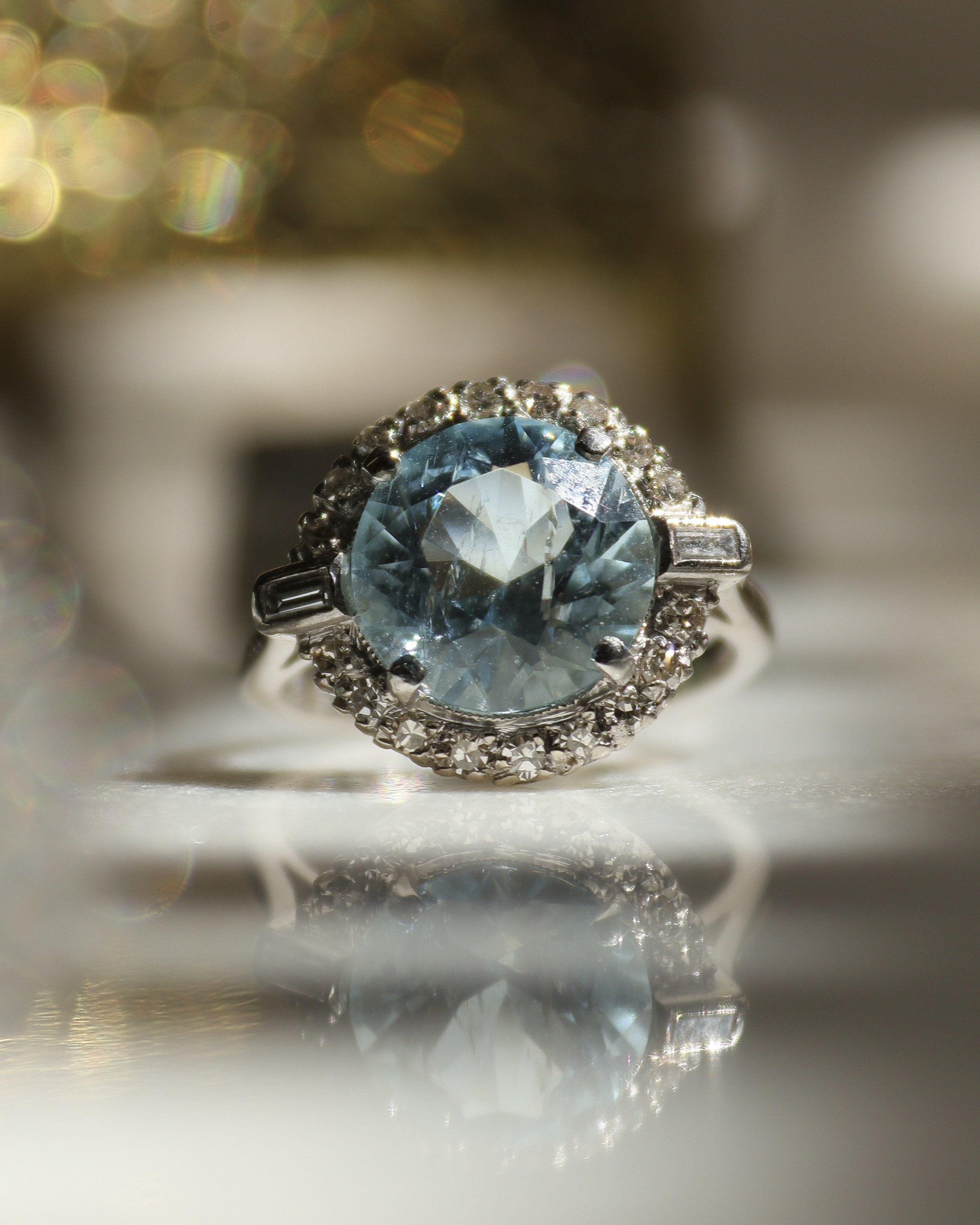
Model wearing an antique aquamarine ring. Thanks, Friar House Antique Jewellery.
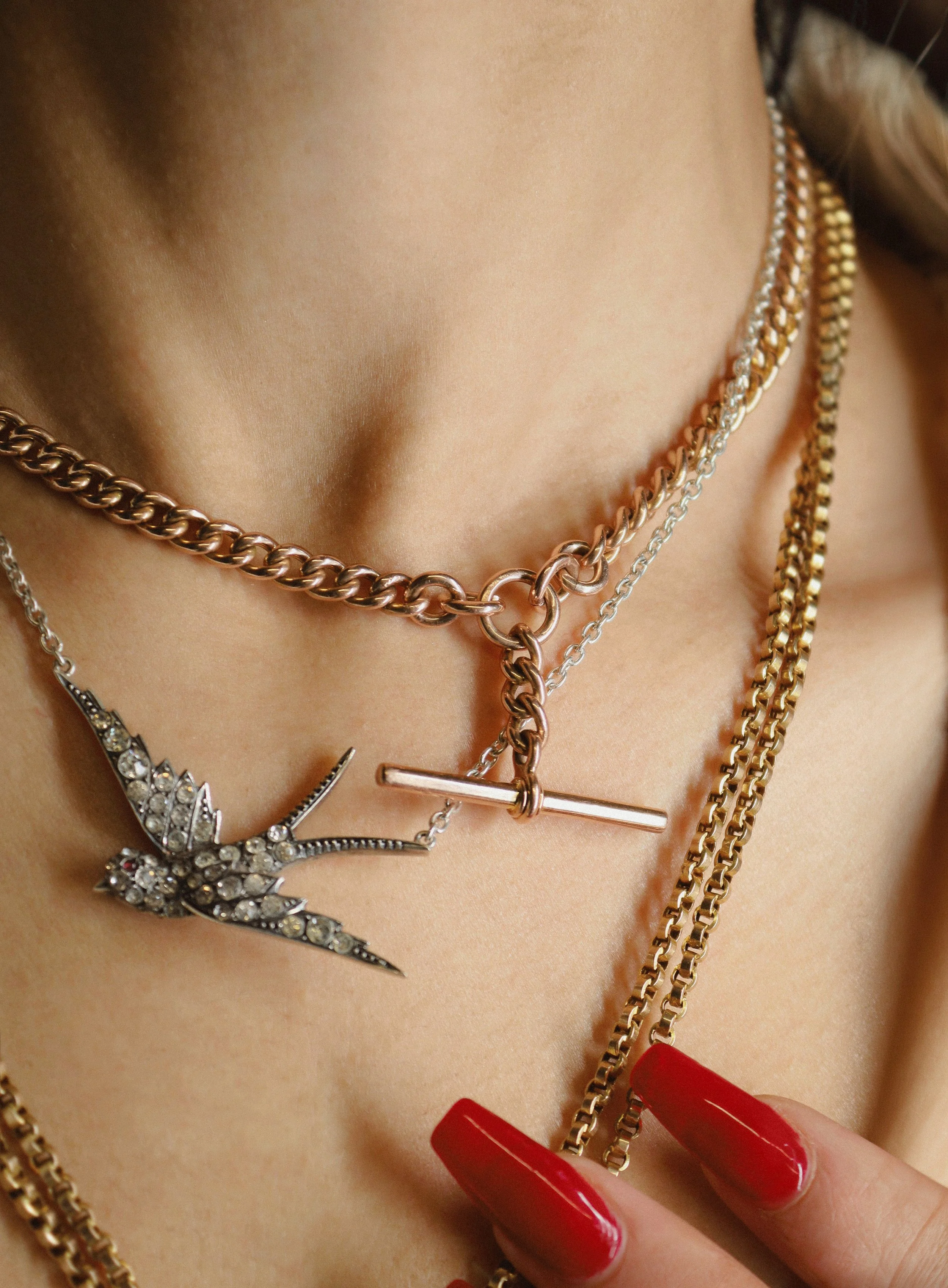
There is a particular necklace everywhere at the moment. A chunky chain, usually gold in colour, fastened at the front with a circular clasp and a small bar passed through it. It appears modern enough, sold alongside contemporary earrings and stacked bracelets, but there is very little modern about it.
The T bar necklace owes much of its current form to the Albert chain, the watch chain associated with Prince Albert and worn widely by Victorian and Edwardian men. The bar had a purpose. It passed through the buttonhole of a waistcoat, anchoring a chain that secured a pocket watch at the other end. Many carried a fob, seal, sovereign holder or other small object. They were practical things that happened to be beautiful.
More than a century later, the pocket watch has largely disappeared but the chain has not. Original Alberts are now worn around women's necks, doubled around wrists and hung with charms. Meanwhile, versions of their distinctive hardware have found their way into contemporary jewellery collections at almost every price point.
This happens constantly in fashion. We rediscover something beautiful, remove it from its history, reproduce it cheaply and sell it back to ourselves as new.
Perhaps we should start buying the original.
Friar House Antique Jewellery
BEFORE IT WAS A TREND
The most interesting thing about antique jewellery is that its details usually existed for a reason. A dog clip clipped onto something. A watch chain held a watch. A seal left an impression in wax. Lockets concealed photographs and mourning jewellery carried the memory of somebody who had died.
Modern jewellery borrows these shapes because they are beautiful, but sometimes the imitation becomes strangely empty. A plastic or plated T bar resembles an Albert chain without possessing the weight, purpose or history that made the original interesting in the first place.
An antique Albert has already lived an entirely different life before arriving in a modern jewellery box. It may have crossed the waistcoat of a Victorian gentleman, carried his watch every day for thirty years and later spent half a century forgotten in a drawer. Now it can sit over a white T shirt and look entirely contemporary.
That is difficult for a factory made copy to compete with.
BUY ONE GOOD THING
We have become accustomed to treating jewellery almost like clothing. A pair of earrings for this season, another necklace for a particular dress, a handful of rings ordered because they looked good in a photograph. Costume jewellery certainly has its place, and some of it is beautifully designed, but the cheapest end of the market has encouraged us to think of jewellery as disposable.
It should be almost the opposite.
Jewellery is uniquely suited to longevity. It does not care if our bodies change. It can move between generations. Gold can be repaired, chains can be altered, stones reset and rings resized. A piece bought at thirty can still be worn at seventy and then handed to somebody else.
There is something rather wonderful about spending the money that might otherwise disappear across ten forgettable purchases on one object that could still exist a hundred years from now.
This does not mean that everybody needs an enormous diamond or an 18 carat gold necklace. Antique jewellery exists at almost every level. A silver Victorian locket, an old signet ring, a small gold charm or a beautifully made brooch can be the beginning of a collection. The point is not conspicuous value. It is permanence.
LET IT HAVE A PAST
New jewellery is perfect. Antique jewellery has evidence.
There are softened edges, tiny scratches, old repairs and engraving that may belong to somebody you will never identify. A ring may contain initials that are not yours. A locket may once have held a photograph that disappeared decades ago.
For some people, this is precisely what puts them off. We think it is the best part.
The obsession with pristine objects is relatively modern. For most of history, beautiful things moved through families. Silver was polished, furniture repaired, clothes altered and jewellery inherited. An object having belonged to somebody else did not diminish it. Its survival was part of its value.
There is also freedom in wearing antiques without treating them as museum pieces. Put an old brooch on a battered jacket. Hang a Victorian fob from a chain. Wear a man's signet ring. Turn an Albert chain into a necklace. The most interesting way to preserve these objects is often simply to keep using them.
LEARN TO LOOK
Buying antique jewellery requires a little more curiosity than clicking “add to basket”, which is another reason we like it.
Begin with hallmarks. British precious metal hallmarks can tell you about the metal and assay office, and historic marks can often help establish age. When buying precious metals, particularly online, knowing what you are looking at matters. The British Hallmarking Council specifically recommends checking hallmarks and buying from reputable sellers.
Look at construction too. Turn jewellery over. Examine the clasp. Look at the back of a brooch and the inside of a ring. On an Albert chain, look for the T bar and original swivel or dog clips rather than simply a modern toggle designed to resemble them. Antique examples can be found in 9, 15 and 18 carat gold as well as silver and other materials.
Condition matters, but perfection should not necessarily be the goal. Wear is expected. What matters is whether the piece remains structurally sound and whether repairs or alterations have been carried out sympathetically.
And if you do not know, ask. A good antique dealer should enjoy telling you what something is.
LEAVE LONDON
London contains some extraordinary antique jewellers. It also contains London prices.
If you are buying your first pieces, look further afield. Small independent jewellers in market towns and regional cities can be treasure troves, particularly businesses that deal in jewellery alongside watches, silver and other antiques rather than specialising exclusively in fashionable vintage pieces.
Then there are antique fairs. Go without looking for anything in particular. The pleasure is partly in handling objects and learning what attracts you. Ask dealers questions, compare prices and photograph things you like before buying. Over time you begin to recognise certain periods, stones and styles without consciously trying.
Auction houses are another excellent hunting ground. Smaller regional auctions in particular can be fascinating because jewellery may appear as part of a wider estate rather than having already passed through several specialist dealers. Read the condition report, understand the buyer's premium and decide your maximum before bidding.
And then there is eBay. It remains one of the great unruly antique markets, containing genuine treasures alongside things that require considerably more caution. Search specifically, inspect every photograph, check seller history and never allow an optimistic description to substitute for evidence. “Victorian style” and “Victorian” are two very different things.
Aquamarine Cluster Ring
DON'T BUY AN INVESTMENT. BUY AN HEIRLOOM.
It is tempting to describe antique jewellery as an investment, particularly when gold prices rise or certain periods become fashionable. Some pieces do appreciate, and precious metal has an intrinsic value that plastic and base metal simply do not. But investment should not be the primary reason to buy jewellery.
Buy the piece you want to wear.
Buy the strange little gold ring that fits perfectly. The locket with somebody else's initials. The Albert chain that feels unexpectedly heavy in your hand. Buy something good enough to repair rather than replace and interesting enough that you might still want it in twenty years.
Then wear it until it becomes associated with you.
Perhaps one day your daughter, son, granddaughter or somebody you have not even met yet will open a jewellery box and know immediately that it was yours. They may wear it differently. They might shorten the chain, add another charm or put the brooch somewhere you would never have considered.
That is not the end of the object's story. It is the reason for buying it in the first place.
Fashion will inevitably return to the past for inspiration. The T bar will disappear and come back again. Lockets will be fashionable, then unfashionable, then fashionable once more. Signet rings, cameos, charm bracelets and old chains will all have their moment.
The antique does not need to wait for any of it.
It was already there.