THE LAST GREAT ECCENTRICS
Once, individuality was cultivated rather than curated. From Diana Vreeland and Cecil Beaton to Isabella Blow and André Leon Talley, we celebrate those rare figures who understood that being yourself occasionally requires becoming something entirely of your own invention.
The photograph of Diana Vreeland sitting in her famous red drawing room in New York. The walls are covered in patterned fabric, cushions compete with flowers, books and objects occupy almost every available surface and Vreeland sits among it all looking not remotely overwhelmed. The room did not merely belong to her. It seemed to be an extension of her.
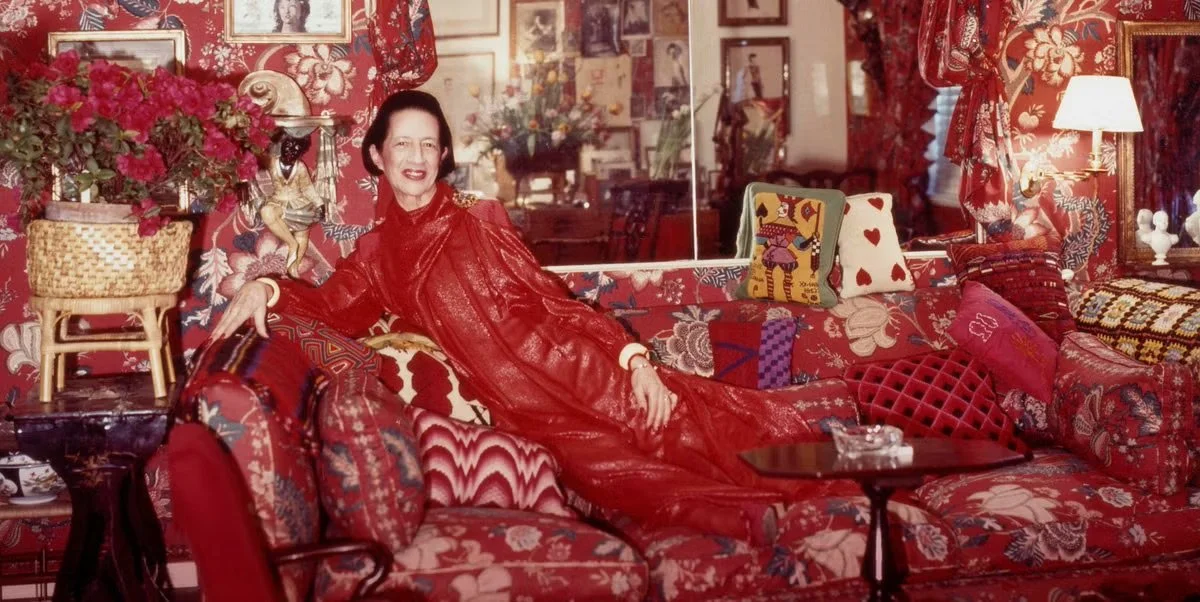
She reportedly instructed its decorator Billy Baldwin that she wanted the room to look like “a garden in hell”. Naturally, he obliged.
It is difficult to imagine anybody describing their sitting room that way now without immediately imagining how well the phrase might perform on Instagram. Vreeland wasn't creating content. She was creating an environment in which she wanted to live.
There is a difference.
The great eccentrics understood this instinctively. They dressed strangely, decorated excessively, collected obsessively and developed opinions about subjects most people had never considered worthy of an opinion. They could be exhausting, brilliant, difficult and occasionally ridiculous, but they were rarely interchangeable.
Where did they all go?
DIANA VREELAND: WHY DON'T YOU?
Vreeland's eccentricity was not merely visual. It was intellectual.
As fashion editor of Harper's Bazaar, editor in chief of American Vogue and later consultant to the Metropolitan Museum of Art's Costume Institute, she possessed an extraordinary ability to make fantasy feel culturally important. She preferred exaggeration to good taste and possibility to practicality. Her famous Why Don't You...? column for Harper's Bazaarsuggested increasingly extravagant ways readers might improve their lives, from washing a child's hair in champagne to decorating maps of the world.
The suggestions were not really instructions. They were invitations to imagine.
Vreeland understood that style had very little to do with possessing the correct objects. It was a way of looking at the world. A person could be beautiful because of an enormous nose rather than despite it. A room could contain too much red. Clothes could transform somebody rather than merely flatter them.
Her great talent was making excess feel like liberation.
CECIL BEATON: LIFE AS A SET
Cecil Beaton seemed unwilling to accept that ordinary life should remain ordinary.
Photographer, designer, diarist, illustrator and social observer, Beaton moved between aristocrats, actors, artists and royalty while continually reinventing both his surroundings and himself. His portraits could be elaborate constructions of fabric, flowers, painted backgrounds and improbable objects, but the theatricality rarely felt separate from his life.
That may be the defining characteristic of the true eccentric. There is no clear point at which the performance ends.
Beaton understood the pleasure of self invention long before the phrase became associated with branding. Clothes, houses, photographs, parties and friendships could all participate in the creation of a life. This could certainly involve vanity, but vanity in Beaton's hands was at least ambitious.
He did not want simply to look interesting.
He wanted the world around him to become more interesting too.
QUENTIN CRISP: REFUSING TO BLEND IN
Quentin Crisp turned refusal into an art form.
At a time when appearing visibly different could carry genuine danger, Crisp made himself conspicuous. He dyed his hair, painted his nails, wore makeup and cultivated an appearance that ensured anonymity was almost impossible. His 1968 memoir The Naked Civil Servant, and the later television adaptation starring John Hurt, transformed him into an unlikely public figure.
There is a tendency now to reduce eccentricity to clothing, but Crisp's appearance mattered precisely because it represented something deeper. He had decided that the effort required to disguise himself was greater than the effort required to withstand being noticed.
His wit became part armour and part philosophy. He could be provocative, contradictory and sometimes deliberately infuriating, but he possessed something increasingly unusual: an apparent lack of interest in achieving universal approval.
The eccentric cannot survive an obsession with being liked.
ISABELLA BLOW: THE HAT ENTERS FIRST
Sometimes Isabella Blow appeared to arrive several seconds after her hat.
Philip Treacy's extraordinary creations became inseparable from her image, but Blow's importance to British fashion went considerably beyond her wardrobe. She recognised talent. Alexander McQueen, Treacy and models including Sophie Dahl were among those whose careers she helped champion.
Her clothes nevertheless mattered because she understood fashion as a language rather than a shopping exercise. Hats could obscure her face entirely. McQueen clothes could distort the body. Colour, feathers, lace and extraordinary silhouettes transformed getting dressed into something closer to theatre.
There was also vulnerability beneath the spectacle. Blow's life and death make it tempting to romanticise eccentricity as though living differently necessarily produces happiness. It doesn't. The interesting thing about her image is not that flamboyance protected her from difficulty, but that clothing became one of the ways she communicated with the world.
She did not dress to disappear into the room.
She dressed to change it.
ANDRÉ LEON TALLEY: MORE IS MORE
André Leon Talley understood scale.
At six foot six, disappearing was never particularly realistic, so he did the opposite. Capes, kaftans and enormous coats became part of an image as recognisable as that of many of the designers he wrote about. Yet reducing Talley to his clothes would miss what made him important.
He possessed an extraordinary knowledge of fashion history. His visual extravagance was supported by scholarship, memory and decades spent observing the people who made clothes. He could connect a contemporary collection to an eighteenth century court dress, a Hollywood costume or something Diana Vreeland had said decades earlier.
That is what separates eccentricity from novelty.
The clothes were not random. They belonged to a larger world of references, enthusiasms and obsessions. Talley had cultivated taste rather than simply acquired things.
A cape becomes considerably more convincing when the person wearing it can explain exactly why it matters.
WHAT HAPPENED TO ECCENTRICITY?
It would be easy to blame social media for everything, and probably unfair. There are wonderfully strange people alive today and the internet has given many of them communities they might never have found otherwise.
But something peculiar has happened to individuality.
We are encouraged constantly to express ourselves while being exposed to exactly the same references. We save the same interiors, discover the same small brands, visit the same hotels, photograph the same restaurants and receive recommendations generated partly by what millions of people resembling us already liked.
Even rebellion can acquire a uniform.
The problem is not that everybody copies one another deliberately. It is that our influences have become increasingly concentrated. The person in London, Copenhagen, New York and Melbourne can now see the same image within minutes. An aesthetic emerges, spreads and is exhausted before most people have worked out where it came from.
The great eccentric developed more slowly.
PERSONAL STYLE IS NOT A SHOPPING LIST
Perhaps this is why genuinely distinctive personal style feels so refreshing when we encounter it.
It cannot be bought in a single afternoon.
The interesting wardrobe contains mistakes. It includes the coat somebody bought fifteen years ago, the ring inherited from a grandmother, the shirt discovered on holiday, the shoes repeatedly repaired and the completely ridiculous thing that somehow works because the person wearing it has worn it long enough.
The same is true of a home. The rooms we remember are rarely those in which everything was purchased simultaneously. They contain evidence of a life: books, photographs, inherited furniture, objects with inexplicable sentimental value and things that would never have been placed together by an interior designer.
Taste requires time because identity requires time.
Perhaps that is why trying to purchase an aesthetic rarely produces one.
THE COURAGE TO BE RIDICULOUS
There is another ingredient in eccentricity that is considerably harder to acquire than clothes.
You have to be willing to look ridiculous.
Every genuinely original person risks getting it wrong. The hat may be too enormous. The room may contain too much red. The opinion may fall completely flat at dinner. Other people may not understand why you have bought the strange painting, worn the velvet suit at lunchtime or decided that your hallway requires a marble bust.
The modern world gives us an extraordinary ability to test our choices against other people's approval before making them. Reviews tell us which restaurant to visit. Likes tell us which photograph worked. Trends tell us which clothes are acceptable and algorithms quietly show us more of whatever has already been approved.
Eccentricity requires occasionally ignoring the data.
It asks a much simpler and more dangerous question: Do I like it?
FIND YOUR OWN REFERENCES
Perhaps the great eccentrics have not disappeared. Perhaps we have simply made it harder for ourselves to become one.
The solution is not to begin wearing turbans because Diana Vreeland did, buy a cape in tribute to André Leon Talley or acquire an enormous hat in the hope of becoming Isabella Blow. That would be imitation, which rather defeats the purpose.
Instead, steal their curiosity.
Read the book nobody has recommended to you. Buy something because it makes you laugh. Keep the ugly chair you inexplicably love. Go to an exhibition without first checking whether everybody else enjoyed it. Wear the inherited jewellery with the new dress. Develop unreasonable enthusiasm for an obscure filmmaker, a particular kind of glassware, medieval churches, Japanese cinema, old perfume bottles or anything else that happens to capture your imagination.
Follow interests until they become peculiar to you.
The great eccentrics did not become memorable because they discovered the correct aesthetic. They became memorable because their clothes, rooms, work, friendships, collections and obsessions gradually assembled themselves into worlds that could not convincingly have belonged to anybody else.
Perhaps that is what we miss when we look back at them. Not simply the hats, the capes or the red rooms, but the glorious sense that nobody had told these people exactly who they were supposed to be.