THE RETURN OF THE DINNER PARTY
Why it might be time to clear the table, open a bottle and start inviting people over again.
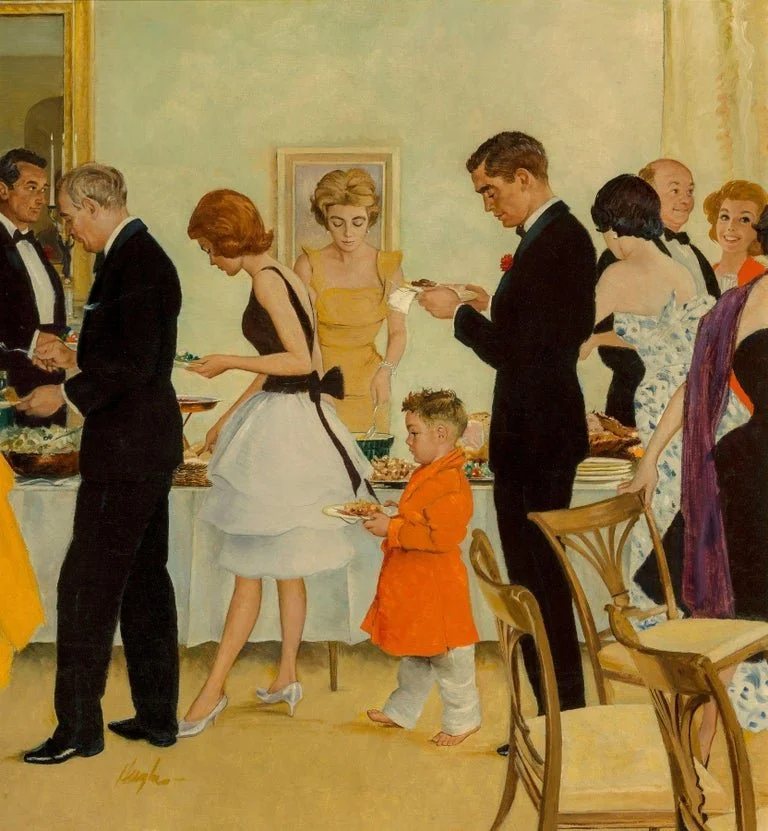
Cover illustration for The Saturday Evening Post, November 11, 1961. George Hughes
There was once a fairly ordinary solution to wanting to see your friends. You invited them to dinner. Not to a restaurant booked three weeks in advance, not to an event and certainly not to sit beside one another while periodically disappearing into separate phones. You asked people to come to your house, cooked something, opened some wine and hoped everybody got along. Somewhere along the way, entertaining at home acquired an unfortunate reputation for being difficult. We began to imagine that hosting required an enormous kitchen, matching crockery and the ability to produce several courses without perspiring. Social media did little to help. The dinner party became the tablescape, and suddenly an evening with friends appeared to require twelve identical linen napkins, handwritten place cards and a flower arrangement that looked as though it had recently won something at Chelsea. This rather misses the point. A good dinner party has very little to do with perfection. In fact, perfection can be fatal to it. The best ones are usually slightly chaotic. Somebody arrives late, the potatoes take longer than expected, there aren't enough matching glasses and by midnight the candles have burned down into old wine bottles while nobody seems particularly interested in going home.
That is the dinner party worth bringing back.
INVITE PEOPLE WHO DON'T ALL KNOW EACH OTHER
There is a temptation when hosting to invite a ready made friendship group. It is safe, certainly, but the great pleasure of a dinner party is its ability to put people together who would otherwise never have met. Invite the photographer and the accountant. The old friend and the new neighbour. Somebody twenty years older than everyone else and somebody who has just moved to the city. The only qualification should be that you think they might have something to say to one another. This was once one of the great social functions of entertaining. People were introduced. Friendships, romances, arguments and occasionally entire careers began because somebody decided that two interesting people ought to sit beside each other for an evening. Our increasingly organised social lives leave surprisingly little room for this kind of accident. Do not, however, become so ambitious that your guests require name badges. Six or eight people is enough. A dinner party should produce one conversation rather than several competing conferences.
COOK SOMETHING YOU HAVE COOKED BEFORE
The evening your guests arrive is not the moment to discover whether you can make a soufflé. Good dinner party food should allow the host to attend their own dinner party. A stew that has spent the afternoon becoming better, a roast chicken, a large dish of pasta, something slow cooked with bread and salad beside it. Food that can be put in the middle of the table and passed around is infinitely more convivial than six meticulously constructed plates emerging from the kitchen at seven minute intervals. There is no shame in buying part of dinner either. Get the pudding from somewhere good. Buy excellent bread. Put cheese on a board and call it a course. The objective is not to convince your friends that a Michelin inspector has accidentally overlooked your house. They came to see you. And if something goes wrong, serve it anyway. A slightly burned tart accompanied by a good story is considerably more memorable than a flawless one served by somebody who has spent the previous two hours having a nervous breakdown in the kitchen.
USE THE NICE THINGS
There is a strange category of possessions many of us keep for a life that never quite arrives. The good glasses. The wedding china. The silver candlesticks inherited from a grandmother. The linen napkins too beautiful to risk staining. Use them. Objects become meaningful through use, not preservation. A wine glass that survives untouched at the back of a cupboard for forty years has had a considerably less interesting life than one bearing the tiny scratches of hundreds of dinners. This doesn't require a matching service of antique china. Quite the opposite. Old plates, different glasses, candlesticks picked up at markets and a tablecloth that has already survived several stains make a table feel collected rather than arranged. Flowers are lovely, but keep them low enough that your guests can see one another. Candles improve almost everything. Overhead lighting improves almost nothing.
DRESS FOR YOUR OWN HOUSE
There is something wonderfully unnecessary about dressing for dinner when dinner is taking place ten feet from your sofa. Do it anyway. Not black tie, unless your friends are unusually game, but something that acknowledges the evening as an occasion. A dress you might ordinarily save for going out. A jacket. Jewellery. Proper shoes, even though nobody can quite explain why shoes matter when you own the floor. The point is not formality. It is ritual. Clothes can mark the transition between the ordinary day and the evening that follows. In the same way that lighting the candles changes a familiar room, getting dressed changes how we inhabit it. There is pleasure in making an effort for people you already know well enough not to bother. Perhaps especially for them.
PUT THE TELEPHONES AWAY
There is no need for a basket at the door or a stern announcement from the host. We are adults. But dinner is better when the phones disappear. The modern telephone has introduced a peculiar third party into conversation. A story begins and somebody remembers a photograph they must show everyone. The photograph leads to a message, the message to another notification and within seconds a person who is physically sitting at the table has quietly left it. Resist the urge to prove everything. If somebody cannot remember the name of an actor, let them not remember it. If there is disagreement about the population of Sicily, allow the question to remain unresolved until morning. Not knowing something for twenty minutes is unlikely to cause lasting harm.Conversation has a different rhythm when there is no possibility of instantly escaping it.
MUSIC SHOULD NOT ASK FOR ATTENTION
The dinner party soundtrack has one job: to make silence feel intentional. Put something on before the first guest arrives and leave it alone. Jazz is difficult to object to. So are soul, bossa nova, old records and almost anything that doesn't suddenly make everybody at the table aware that the host has been curating a dinner party playlist for four hours. Volume matters more than taste. If your guests have to compete with the music, it is no longer background music. If nobody notices when the record ends, you have probably got it right. Later in the evening, of course, all rules may be abandoned. Some dinner parties ought to end with dancing in the kitchen.
DON'T CLEAR EVERYTHING TOO QUICKLY
A perfectly cleared table can feel suspiciously like being asked to leave. There is a moment after dinner when the plates are empty, the glasses have been refilled and everybody has settled properly into the evening. Do not destroy it because there are dishes in the sink. Clear what is necessary. Bring out pudding, cheese, another bottle or coffee. Allow the table to acquire the debris of a good evening. Corks, crumbs, candle wax, half empty glasses and abandoned napkins are not evidence of failed housekeeping. They are evidence that something happened there. The washing up will remain remarkably patient until morning.
DON'T MAKE IT A PERFORMANCE
Perhaps this is the most important part. Your home is not a restaurant and your friends are not customers. Nobody is reviewing the service. The evening does not need a concept, a colour palette or a photograph of the table before anybody is permitted to touch it. Hospitality is not the performance of having a beautiful life. It is allowing other people into the life you actually have. If the house is small, squeeze in. If you do not own eight chairs, borrow two. If the dining table is also where you work, clear the laptop away. If the wine is inexpensive, pour it generously. The generosity matters considerably more than the grandeur. There is an intimacy to being invited into somebody's home that restaurants cannot reproduce. You see the books they keep beside the bed, the picture hanging slightly crooked in the hallway, the records they actually listen to and the kitchen they inevitably end up standing in at one in the morning.
INVITE THEM
Perhaps the dinner party disappeared partly because arranging our lives became strangely complicated. We spend weeks trying to find a date on which everybody is available and eventually settle on something six Thursdays from now. By then half the group has forgotten why they were meeting. So make the invitation. Do not wait until you have the right table, the larger house or the set of glasses you intend to buy one day. Invite six people next Friday. Cook the thing you know how to cook. Put candles on the table, open the wine before they arrive and wear something you like. There may be a stain on the tablecloth by the end of the night. Someone may stay considerably later than expected. Two people who arrived as strangers may leave exchanging numbers. The food may not be the thing anybody remembers.
That is rather the point.