SORRY, ARE WE FAT AGAIN?
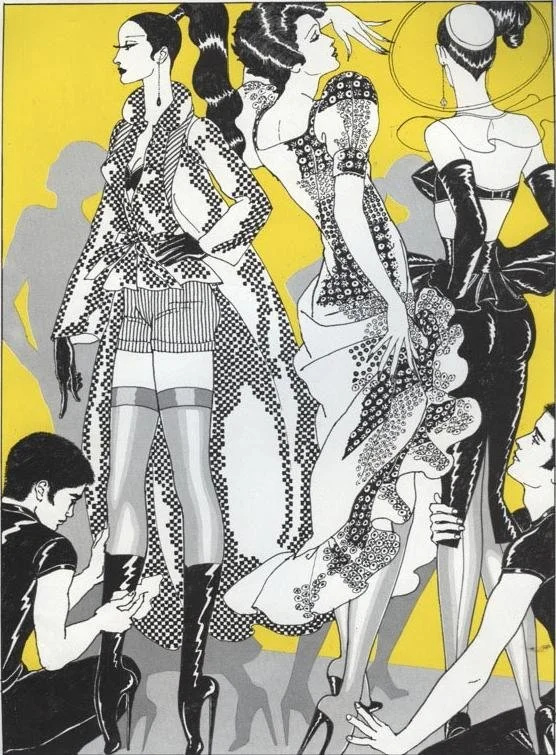
Antonio Lopez Fashion illustrator
Thin is back, apparently. The fashionable body has changed once more and, frankly, we’re tired.
Something rather exhausting has happened to bodies again.
For a few years there, we appeared to have reached a tentative agreement that human beings came in different sizes. There were stomachs in advertising. Thighs touched. Models occasionally possessed breasts. Stretch marks appeared in beauty campaigns so frequently that they briefly seemed to have their own agent.
Brands discovered body positivity and naturally behaved as though they had invented it. Every moisturiser advert became a civil-rights movement. We were encouraged to love our rolls, celebrate our cellulite and gaze adoringly at ourselves in our underwear while somebody attempted to sell us deodorant.
It could all get a little much, but the basic premise was rather nice: perhaps we could stop treating women's bodies as renovation projects.
Anyway, thin is back.
That was quick.
GLP-1 drugs have changed medicine and, for people who medically need them, can be enormously valuable. This isn't an argument against them. What somebody takes under medical supervision is between them and their doctor, and the rest of us can find something more interesting to discuss.
The peculiar part is what popular culture has done with them.
Within about five minutes, a serious class of medicines became an aesthetic. Celebrity bodies began shrinking, speculation began, photographs were compared, and suddenly we were back examining women's upper arms as though they contained important evidence.
Who's on Ozempic? Who isn't? Who has admitted it? Who has lost too much? Who looked “better before”? Who has become “tiny”?
Dear God.
Didn't we just do this?
We have apparently spent several years discussing body acceptance only to discover that our acceptance was conditional upon the fashionable silhouette remaining fashionable.
And fashion, naturally, has changed its mind.
FASHION, WE NEED TO HAVE A WORD
There is something else I've always found peculiar about the fashion industry's relationship with thinness.
We are repeatedly told that extremely thin models are necessary because clothes “hang better” on them.
Do they?
Or is it simply considerably easier to make clothes look good when the person wearing them has been selected to resemble the proportions of the original sketch?
Because if your £4,000 dress only looks good on a six-foot woman with extraordinarily long legs, narrow hips and almost no body fat, I have a slightly uncomfortable question.
How good is the dress?
I mean it.
Put a bin bag on a twenty-year-old model with extraordinary bone structure, photograph her in directional light and somebody in Paris will call it challenging.
The real test of design surely isn't whether you can make an already extraordinary-looking body look extraordinary.
Make something beautiful for the five-foot-two woman with a stomach.
Make trousers that look sensational on big thighs. Cut a jacket that gives a broad woman extraordinary proportions. Make a dress that does something magnificent with a large bust rather than behaving as though breasts were an unexpected technical fault.
Now I'm interested.
That is design.
There is a strange lack of ambition in creating clothes for one very specific body and then demanding the world's bodies change to accommodate them. Imagine an architect designing a house that only worked for people over six foot three and blaming the occupants.
Perhaps the house isn't very good.
And yes, runway samples have practical constraints. Designers need standardised samples, casting happens quickly, and clothing hangs differently on different bodies. But those practical realities have somehow hardened into an aesthetic ideal, and then that aesthetic escapes the runway and begins telling everybody else what beautiful is supposed to mean.
Fashion is meant to understand proportion.
So understand some more proportions.
I DON'T WANT TO LOVE MY BODY EITHER
This is where I depart slightly from traditional body positivity.
I don't particularly want to “love every inch”.
It sounds exhausting.
There are parts of my personality I don't love every day, never mind my knees.
The demand that women progress from hating their bodies to standing naked in front of a mirror whispering affirmations at their stomachs was always slightly deranged. There is another option between self-loathing and wanting to marry yourself.
Neutrality.
Your body can simply be your body.
Some days you look fantastic. Some days you discover a changing-room mirror apparently designed by a war criminal. Life continues.
Perhaps the goal isn't body positivity at all. Perhaps it is becoming sufficiently interested in the rest of your life that you don't spend quite so much time thinking about your thighs.
COULD WE TRY BEING DIFFICULT TO KNOCK OVER?
We have also performed the old cultural trick of confusing thinness with health.
They aren't synonyms.
A person can be thin and unhealthy. A larger person can exercise, eat well and have excellent health markers. Weight can matter medically, of course, but health is considerably more complicated than whether your collarbones are currently fashionable.
And as we get older, there is something else worth thinking about: muscle.
Strength matters. Bone health matters. Maintaining muscle becomes increasingly important with age, and resistance training is useful for strength, physical function and bone health.
None of this makes a particularly sexy beauty campaign.
THIS SEASON: ADEQUATE BONE DENSITY.
I'd buy the magazine.
Perhaps instead of trying to become progressively smaller as we age, we could aim to become progressively harder to knock over.
Lift weights. Carry things. Walk. Climb stairs. Eat enough protein. Feed yourself properly. Maintain muscle. Look after your bones.
I want seventy-year-old women with excellent shoulders.
I want eighty-year-olds who can get off the floor without summoning assistance.
I want old ladies carrying their own suitcases through railway stations in enormous sunglasses.
That is aspirational.
AND HAVE THE BLOODY CAKE
The other tedious development has been the moralisation of absolutely everything we eat.
Sugar is bad. Bread is bad. Wine is bad. Seed oils are apparently plotting our deaths. Chocolate is acceptable only if it contains so much cacao that eating it resembles licking a Victorian writing desk.
Could we calm down?
Of course we should eat well. Vegetables, protein, fibre, good fats, proper meals. Don't live entirely on beige food delivered by motorcycle.
But health is a pattern, not one piece of cake.
Have the cake at the birthday. Have pasta in Rome. Have the beautiful glass of wine with dinner. Eat Christmas pudding without explaining to everybody that you “never normally have dessert”.
Nobody asked.
The purpose of health, surely, is to allow us to participate more fully in life. It would be an extraordinary administrative error to spend your entire life preserving your body while refusing to let it enjoy anything.
THE BODY TREND MUST END
What I find most absurd is that we continue talking about bodies as though they're hemlines.
Curves are back.
Curves are over.
Strong is sexy.
Skinny is back.
Big bottoms.
Small bottoms.
Thigh gaps.
Pilates arms.
Ozempic face.
Heroin chic.
Enough.
You cannot expect a human being to remodel herself every four years because somebody changed the moodboard.
And perhaps fashion bears more responsibility here than it likes to admit. If the industry genuinely believes in creativity, then give designers the most interesting challenge imaginable: make beautiful clothes for the bodies that actually exist.
Tall ones. Short ones. Thin ones. Fat ones. Muscular ones. Old ones. Bodies with enormous breasts and absolutely none. Bodies that have had children. Bodies whose waists disappeared sometime around 1998 and have shown no intention of returning.
Make those people look fantastic.
Because if the solution to making your clothes look beautiful is requiring the customer to become six feet tall and a size zero, I'm afraid you've outsourced rather a lot of the design work to the customer.
And she has enough to do.
So perhaps the next body movement could involve no movement whatsoever.
No celebration. No transformation. No summer body. No revenge body. No “getting back” to the body you had at twenty-three, who, incidentally, probably wasn't nearly as happy with it as you now remember.
Eat well most of the time. Lift something heavy. Walk. Sleep. Have dinner with people you love. Take medicine when you medically need it. Have the wine sometimes. Have the cake sometimes. Wear clothes that fit the body you actually possess.
Then get older.
Get stronger if you can. Get wrinkled. Become increasingly opinionated. Maintain sufficient bone density to remain upright and buy an excellent coat.
Frankly, if at eighty-five you can carry your own shopping home, open a bottle of wine and complain about the cut of contemporary trousers, I think you've won.