DRESSED FOR THE PART
Before the influencer, there was the movie star. And nobody ever asked Alain Delon for a link to his shirt.
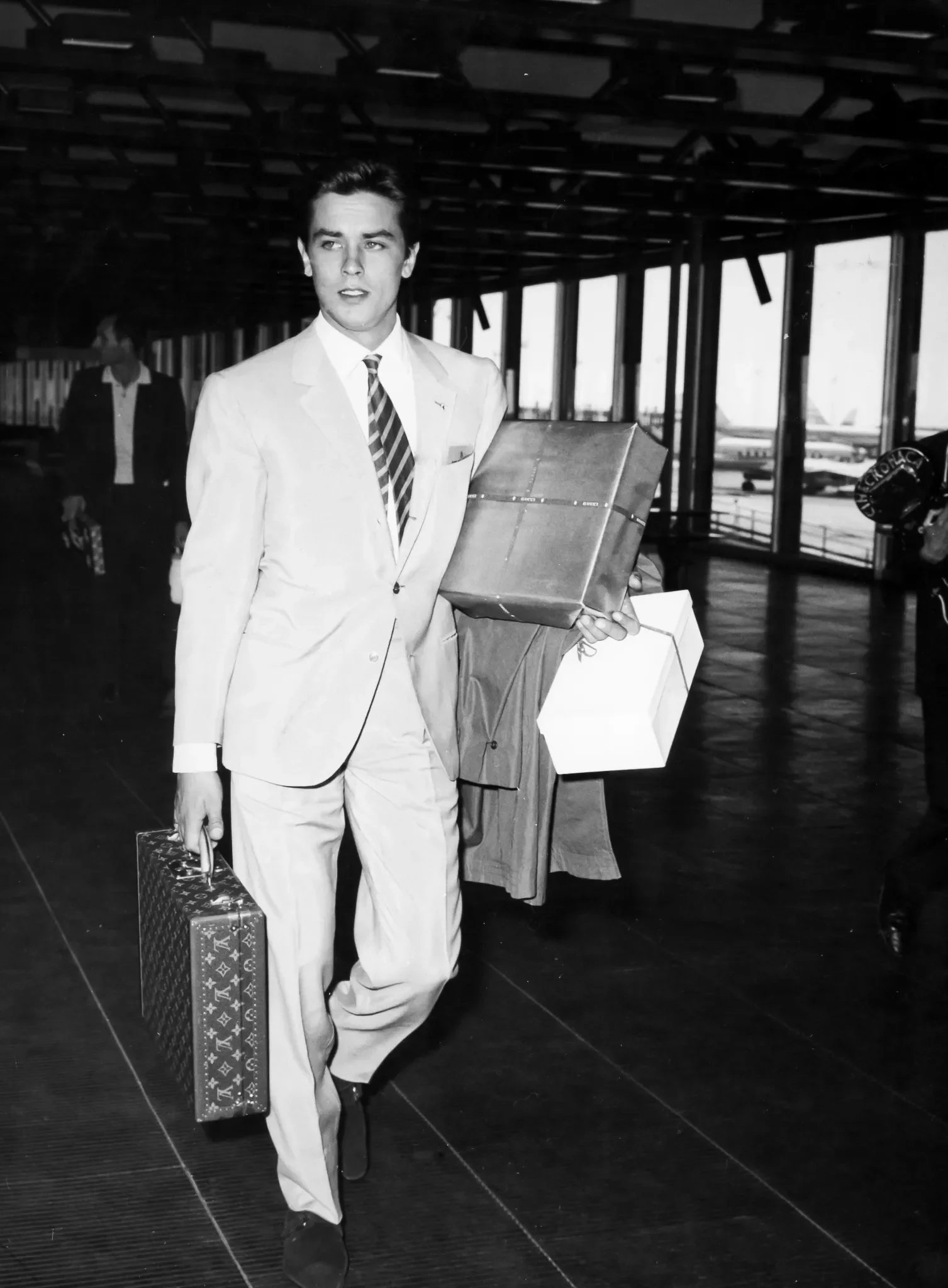
Alain Delon. Getty Images
I have wanted to dress like Alain Delon in Plein Soleil for years. This presents certain practical difficulties, not least that I am not a French man in 1960, but the clothes themselves are almost beside the point. A pale shirt with the sleeves pushed up, cream trousers, loafers, a watch. Nothing remotely extraordinary. Put the same things on somebody outside Pret and you might not look twice. Put them on Delon, give him a yacht, the Mediterranean and murderous intentions, and suddenly you want the lot. Cinema has always been very good at doing this to us. Long before we were saving outfits on Instagram or asking strangers in comment sections where their trousers came from, films were quietly telling us how we wanted to look. Not necessarily what we wanted to buy, which is a slightly different thing. Fashion advertising sells clothes. Cinema sells the possibility that if you owned a particular coat, you might also acquire some of the life happening inside it. This is considerably more powerful. Think of Diane Keaton in Annie Hall. The waistcoats, men's trousers, ties, hats and shirts shouldn't really add up to anything seductive. On paper she sounds like a very small geography teacher. Instead, the clothes became so inseparable from Annie that women have been borrowing from them ever since. Or Marcello Mastroianni in 8½, wandering around in that black suit, white shirt, narrow tie and dark glasses looking exhausted by his own existence. There are more flamboyant costumes in cinema, certainly, but few have made being professionally overwhelmed look quite so appealing. This is where film clothes become interesting. The outfits we remember aren't always the spectacular ones. Often they're incredibly ordinary. Steve McQueen wore chinos. James Dean wore a white T-shirt. Jean Seberg wandered around Paris in Breathless wearing a striped top and cropped trousers. Robert Redford spent much of Three Days of the Condor in a navy peacoat. None of these things required a costume department to invent a new species of garment. What changed was the person inside them. And, perhaps more importantly, what that person was doing.
CLOTHES NEED A PLOT
A fashion photograph has an enormous disadvantage: nothing has happened yet. The coat is pristine. The shirt is tucked correctly. The shoes have never encountered a puddle. Everybody involved knows that the clothes are the reason we're here. Cinema gives them something to do. A shirt gets slept in. A jacket is thrown over a chair. A dress enters a restaurant where somebody shouldn't be. A man spends three days in the same suit and by the end of it the suit knows more about him than his wife does. Clothes become better when they're allowed to participate in the story.
This is why I think costume can sometimes be more influential than fashion itself. You don't remember Gwyneth Paltrow's clothes in The Talented Mr Ripley simply because they are beautiful, although they are. You remember the headscarves, skirts, bathing suits and little cardigans because they belong to Marge Sherwood's life. They have sunshine on them. They sit beside old luggage and hotel rooms and boats and martinis. They are part of a world you briefly believe you could enter.
Jude Law's Dickie Greenleaf is even worse for this. Knitted shirts, linen, loafers, swim shorts, tailoring that looks as though nobody has ever discussed tailoring with him. Dickie is rich enough not to appear interested in clothes, which of course requires extremely good clothes. Tom Ripley understands this immediately. Clothing in that film isn't decoration. It is class, envy, identity and aspiration. Tom doesn't simply want Dickie's possessions. He wants to know what it feels like to be the man who owns them. There is an entire fashion industry contained in that thought.
SOMETIMES THE COSTUME DESIGNER GETS INTO YOUR WARDROBE
Costume designers are extraordinarily good at making us desire things without appearing to sell them to us. Take American Gigolo. Richard Gere's wardrobe, designed with Giorgio Armani, helped establish an entirely different idea of masculine tailoring: soft, fluid, unstructured, sensual. Gere doesn't appear imprisoned inside his suits. He lounges in them. There is that famous sequence of Julian laying clothes across the bed, assembling himself for the evening. Jackets, shirts and ties are handled almost erotically. You understand that clothes are part of the character's equipment. He knows what they do for him. The effect on menswear was enormous, but watching the film now, it doesn't feel like watching an Armani advert. It feels like watching a man who knows precisely how he wants to be seen.
That distinction matters.
Great costume tells you something before the actor opens their mouth. Catherine Deneuve in Belle de Jour, dressed by Yves Saint Laurent, is practically a dissertation on this. Everything is immaculate. The little coats, severe dresses, neat shoes, perfect hair. Her clothes present a woman in complete control while the film spends its time revealing the much stranger life underneath. The clothes don't explain her. They make her more mysterious.
THE DANGER OF LOOKING TOO STYLED
There is a point at which good costume becomes noticeable as Good Costume, and then I start to become suspicious. You know the sort of period drama where everybody has apparently collected their clothes from the costume department that morning. Nothing has been washed incorrectly. Nobody owns an old jumper. The poor characters have beautifully distressed poor-person clothes, the rich characters have immaculate rich-person clothes, and you can practically hear someone backstage saying, “Can we make this feel more lived-in?” Actual people are far less coherent. They repeat things. They own clothes from different periods of their lives. They wear something expensive with something terrible. They keep a coat long after it has ceased being fashionable because it fits properly and replacing it would be annoying. The films with the best style often understand this.
Faye Dunaway in The Thomas Crown Affair is dressed magnificently, but you believe she enjoys clothes. Audrey Hepburn's wardrobe in Charade is absurdly chic, but it belongs to the heightened pleasure of the film. Tilda Swinton in I Am Love doesn't merely wear beautiful clothes; the clothes tell us about control, wealth, restraint and eventually its collapse. And then there is A Single Man, which is so immaculately dressed that almost everybody in it looks as though they might have been ironed. In that particular film, it works.
WE DIDN'T KNOW WHERE TO BUY IT
There was another advantage to learning style from films: for the most part, you couldn't immediately buy what you saw. This may have been healthy. You watched a film and liked somebody's jacket. That was the end of the available information. There was no tagged product, no affiliate link, no account devoted to identifying the precise manufacturer of the socks. You had to interpret it. Perhaps you went looking for something vaguely similar. Perhaps you already owned something that could be worn differently. Perhaps you simply absorbed the proportion, the colour, the attitude. In other words, you copied the idea rather than the product. Now we can identify almost anything on screen within minutes. There are websites devoted to it, Instagram accounts, Reddit threads, costume breakdowns and shops waiting to sell the exact thing. Useful, certainly. But something gets lost when inspiration becomes procurement. The point of wanting to dress like Alain Delon isn't really to locate Alain Delon's shirt. It is to work out why the bloody shirt looks so good.
THE CLOTHES ARE ONLY HALF OF IT
This is the inconvenient truth about movie-star style. You can buy the Persol sunglasses. You can find the loafers. You can have the trousers altered to precisely the correct width. You still won't be Steve McQueen. This is probably for the best. Imagine how exhausting restaurants would be. What cinema teaches us, when it is doing clothes properly, is that style is rarely about the individual object. It is about proportion, repetition, character and context. It's the way somebody pushes up a sleeve, wears a man's shirt, leaves a jacket unbuttoned or keeps the same coat for half the film. The clothes we remember have usually stopped looking like costumes. They've become evidence of a person. And perhaps that is why films remain such a good place to learn how to dress. Fashion tells us what is new. Shops tell us what is available. The internet, with tremendous efficiency, tells us what everybody else is buying. Cinema gives us something much less useful and considerably more seductive: somebody to become for a couple of hours. So watch the film. Steal the proportions. Copy the white shirt, the ridiculous sunglasses, the headscarf, the coat, whatever has lodged itself in your brain.
Just don't ask Alain Delon for the link.